
LEARNED IT · 09/26
A raw frame always looks soft — stacking is selection, then noise, then sharpening
Scrolling through a SER in Siril shows single raw frames, and at 0.22"/px a single raw frame of a planet can never look crisp. Stacking picks the lucky frames, averages the noise out, and only then does sharpening give the edge back. None of that had been done.
Went through every SER from 11 September in Siril and concluded none of them was any good. Not focused, not crisp, and no idea whether the fault was me, the kit, the focus or the air.
What I was actually looking at was single raw frames. Siril opens a SER as a sequence and shows one frame at a time. Nothing had been stacked. And a single raw frame of Venus at this image scale cannot look sharp, for two reasons that have nothing to do with the night:
- The sampling. Venus was 155 px across at 0.222"/px. The diffraction limit of a 102 mm scope alone makes the limb edge about 5 px wide. Any seeing on top of that makes it 10 to 25 px. Zoomed to 100% in Siril, that edge is a fuzzy ramp every single time. 50% zoom is the honest view for this camera. See [[diffraction-is-the-real-ceiling]].
- Venus has nothing to show. In visible light it is a featureless cloud deck. A good Venus is a clean, colour-free crescent with a hard limb, and that is all it will ever be. "Crisp" as in detail needs the Moon or Saturn.
What stacking gives, in order
Re-ran two of the runs the morning after: worst frame, best frame, best 30 of 100 aligned and averaged, then the same stack with the red and blue channels shifted back onto green and a mild unsharp mask.
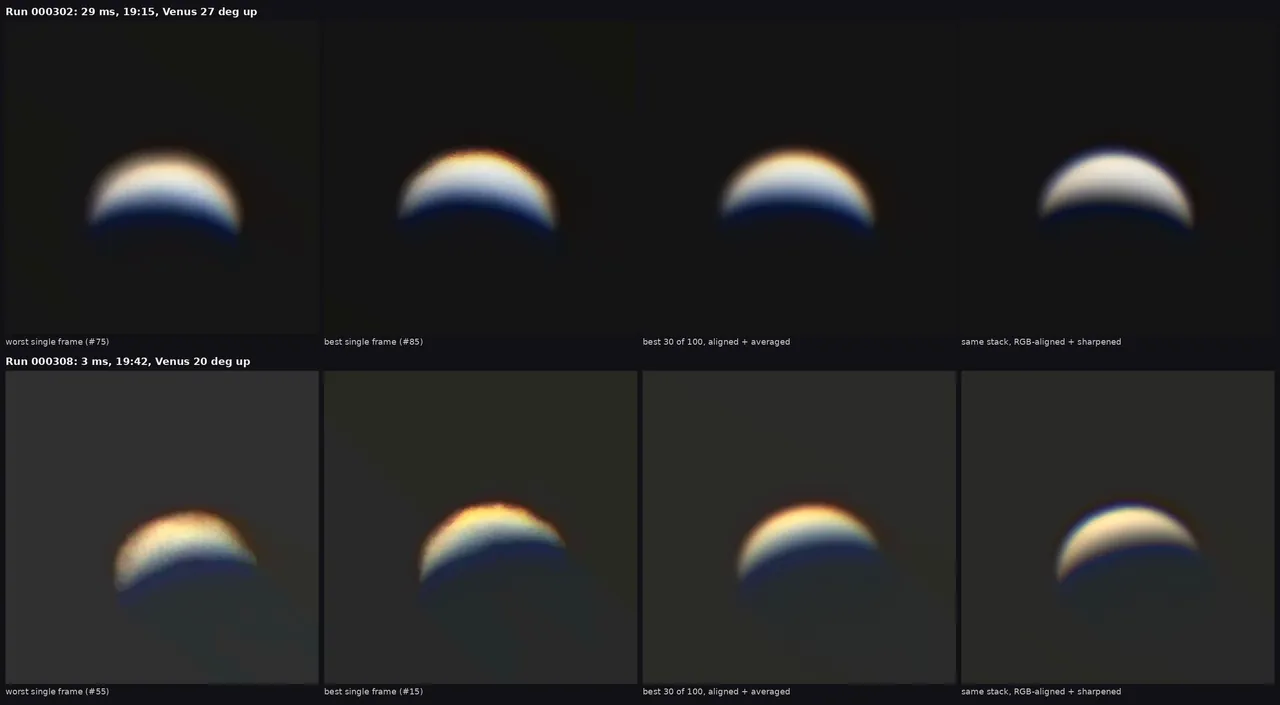
- Selection. Score every frame for sharpness and keep the best 10–30%. The result reflects the lucky moments, not the average air. With 100 frames per run there is almost nothing to select from; this is why runs need to be minutes long.
- Averaging. Aligning and averaging N frames cuts the noise by roughly √N. The 3 ms run, grainy as a single frame, comes out smooth.
- Sharpening. A single frame is too noisy to sharpen. A low-noise stack can take wavelets or deconvolution, and that is where the crisp look comes from.
The stack itself is not sharper than the best single frame. On the 29 ms run the limb edge was 15 px on the best frame, 20 px median, 19 px on the stack, 17 px after sharpening. Stacking buys a clean canvas; sharpening paints on it.
The tool
Siril will stack a SER and its wavelets and deconvolution are fine for the last step, but it is a deep-sky tool at heart. The planetary stackers are AutoStakkert (Wine) and PlanetarySystemStacker (native Linux, Python). Both open SER, do quality selection, alignment and RGB alignment in one pass, and hand a TIFF to Siril for sharpening.
The verdict on the night
Not me, not the scope, not the focus. Altitude and timing, as [[altitude-beats-everything]] already said: 27° at the start, 20° by the end, 42° at sunset an hour earlier. The focus bracket had already shown focus at or near the minimum. The frames were normal for that air. The mistake was judging them raw.