
LEARNED IT · 10/26
The detail was in the recording — the stack was hiding it
The first Saturn stacks from the ZWO came out as white, colour-fringed blobs. The same recordings, put through a proper planetary chain, showed the ring gap, the ring shadow and a belt. Selection at full resolution, sub-pixel alignment, lining up the colour channels, deconvolution, and a tone curve that does not burn out the globe.
Sixteen Saturn recordings on 29 October, and every stack looked like the left half of this:
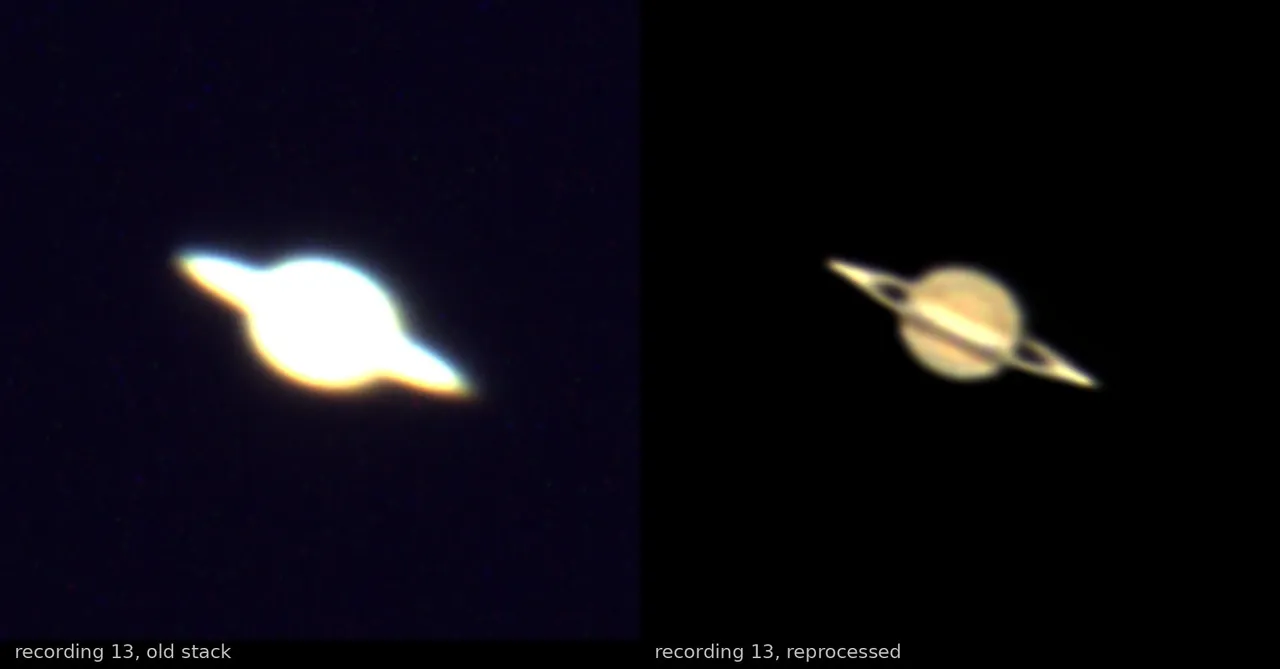
The right half is the same recording, #13. Nothing about the night changed. Only the processing did.
What the old stacker did wrong
- It judged sharpness on a quarter-size picture of the whole frame. Saturn is about 110 pixels across in a 1920-wide frame. Shrunk four times it is 27 pixels, and the score is mostly noise. See [[sharpness-metrics-reward-noise]].
- It shifted frames with blurry interpolation. Every aligned frame got softened a little.
- It never lined up the colours. Low in the sky, the air bends blue light more than red, so the three colour images land in slightly different places. Here blue was 1 px above green and red 1 px below, which is the blue top edge and red bottom edge on the blob.
- It stretched the result to the brightest pixels in the frame, which burnt the globe white and hid every belt.
The new chain
- Crop around the planet in every frame, 384 px square, and score sharpness there at full resolution, relative to brightness.
- Keep the best 15% of a long recording (about 228 of 1,525), or 30% of a short one.
- Align at sub-pixel accuracy, by matching each frame's pattern against the best frame and shifting it exactly, with no interpolation blur. Then align everything again against that first stack.
- Line up red and blue on green. One pixel each way, every recording.
- White-balance on the planet itself, then warm it slightly. Saturn is cream and tan.
- Deconvolution: undo a blur about 2.7 px wide, 30 rounds. This is where the detail comes back. Too little and it stays soft; too much and the globe goes blotchy and the ring tips go spiky.
- Gentle wavelet sharpening on the middle scales, with the finest scale treated as noise.
- Tone it down: the globe's brightest part at 80%, not 100%, so the bands show.
- Enlarge four times onto black.
The scripts are in the night's reprocess/ folder, not in astro-rig yet.
What it can't do
It cannot beat the aperture or the air. On 29 October the seeing was about 3 arcsec and the 127 resolves 1.1. The new chain gets out what the recording holds and no more. The same recordings will never show the Cassini division; an 8-inch on a steady night would. See [[diffraction-is-the-real-ceiling]] and [[altitude-beats-everything]].
It is the same lesson as [[stacking-is-selection-then-sharpening]], one step further: the stack is only the canvas, and a bad stack hides what the canvas could have shown.