SESSION 13 · 09/26 · WORKED
The whole Moon, and a search that found Saturn
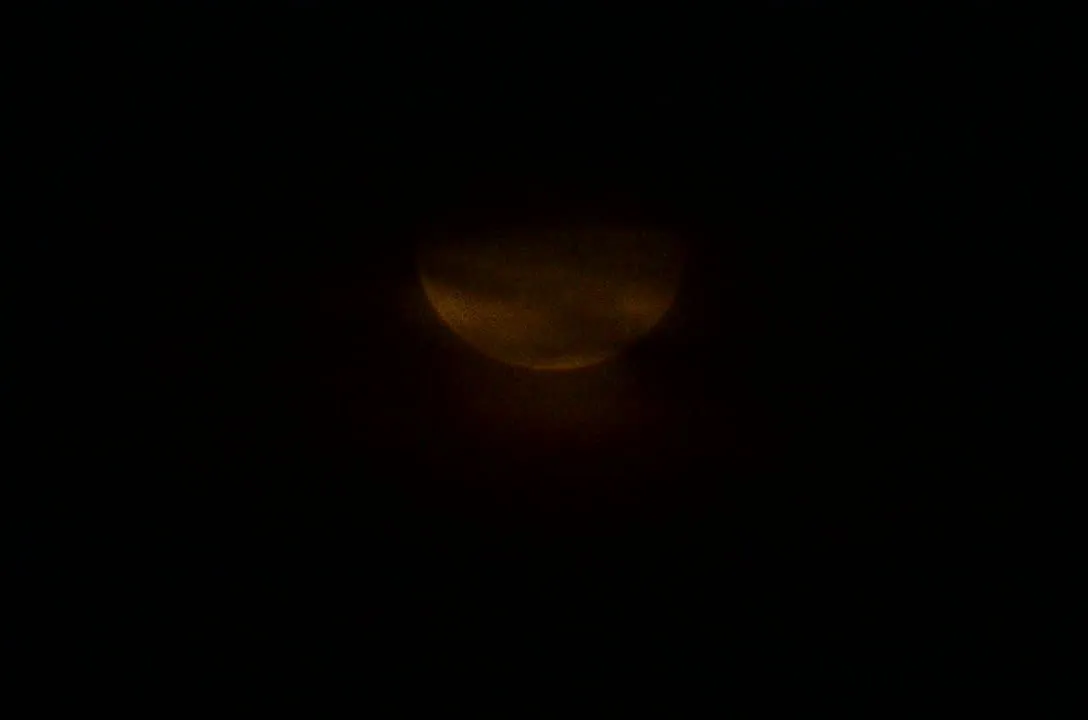
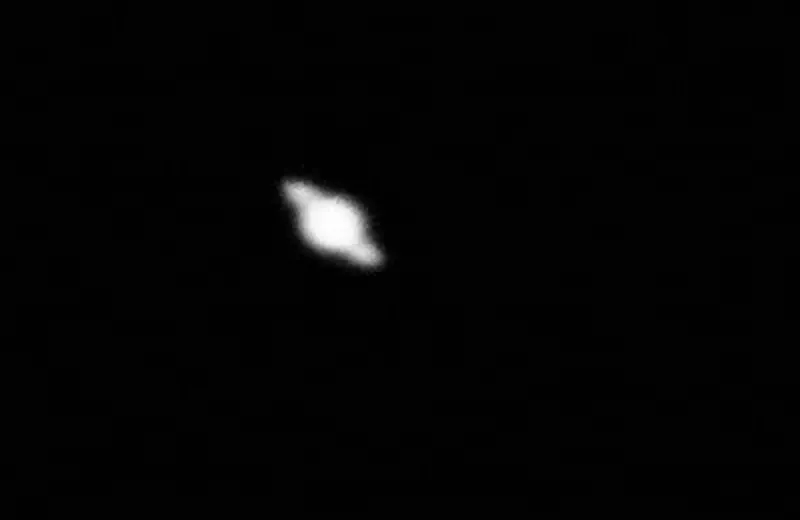
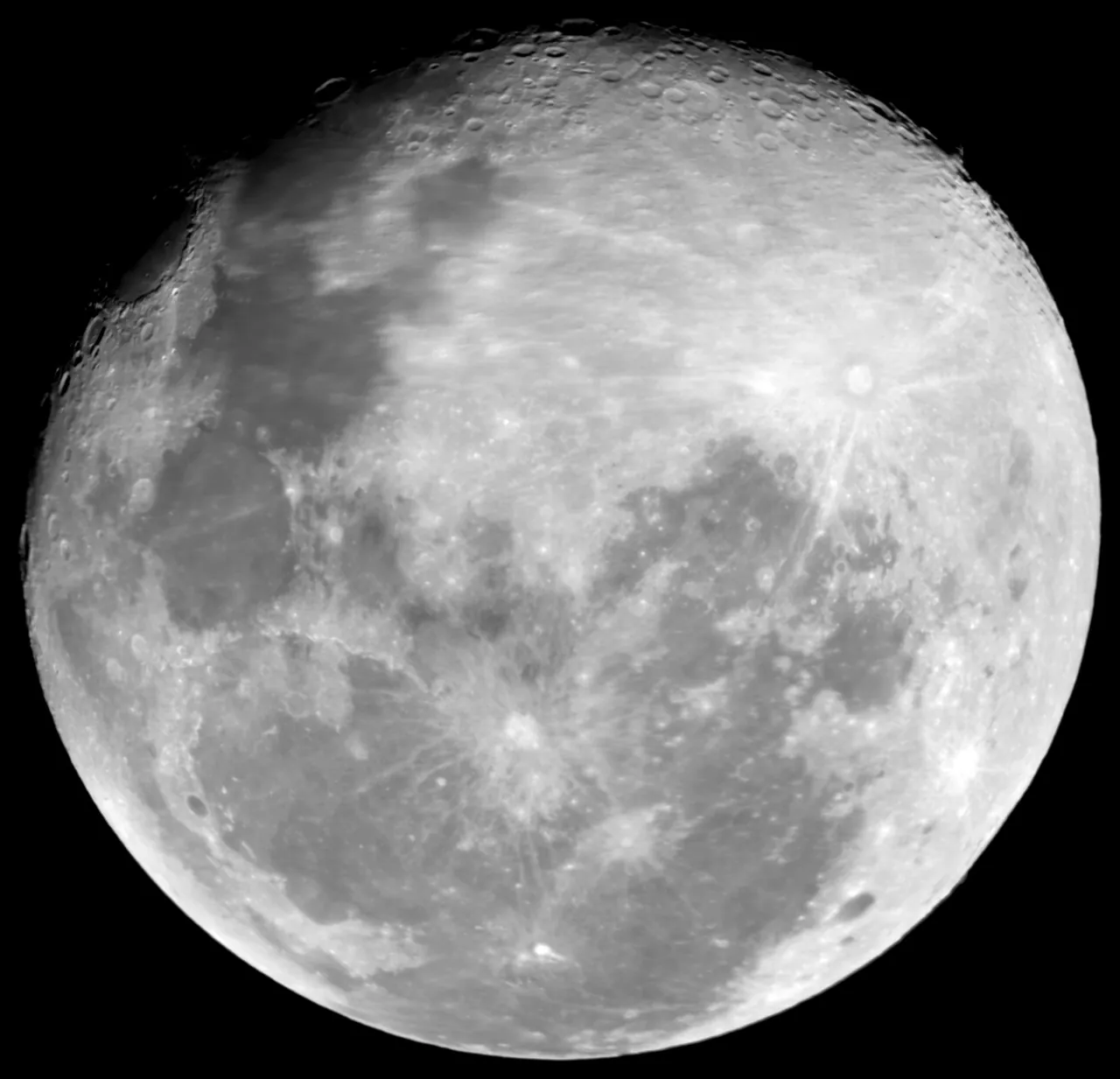
A complete Moon at last - 24 panels, 100% of the sunlit disc, measured and not just looked at - and my first Saturn, rings and all, in a single overexposed frame. On the way: a spiral search built at the eyepiece that found Saturn in two and a half minutes, a go-to that "overshot by 300.8 degrees" because two threads were reading each other's mail, a crosshair drawn in the wrong place, and cloud that took Saturn just as the focus came good.
Set up from about 19:00, the laptop indoors and the scope outside. Written up at 23:30.
The forecast said 90-99% high cloud until about 1 am, thinning after 2. It was right about the cloud and wrong about how much of the night it would cost: most of what follows was shot through it.
The setup constraint that shaped the night: with the laptop inside and the scope out, the only sky I can see is the north-east. Venus was bright in the west-south-west at 19:30 and set at 21:02 - out of reach. Saturn (a week from opposition) and the rising Moon both came up through the north-east, which made them the night.
The pointing was twelve degrees out
The mount had been switched on well off true north. The first rig-ui alignment, on the Moon at 2.7 degrees in the finder, put the home bearing at +12.17 deg. The SynScan app's own Saturn alignment "worked", and the camera saw black at 30 ms and at 150 ms - Saturn would saturate at either.
The camera's field is the problem, not the mount. The SV205 on the Mak sees 13.9' x 9.2', a third of the Moon's width. Five arcminutes of error is a miss.
The spiral search, built at the eyepiece
The idea was mine: leave the scope where it is, have the mount weave outward from there, and press a key when the target shows. Claude built it into rig-ui as a Search panel:
- a square spiral of camera fields, sized from the camera's transform with 20% overlap;
- the mount tracks between fields, so every field stays put on the sky relative to the start;
- Space = found. If it is pressed within 0.8 s of the field changing, it goes back one, because I was reacting to the field before;
- optional auto-stop on anything bright in the frame;
- a coverage map of every field looked at, click one to go back to it, and Continue never repeats a field. Any other move - a jog, a go-to, STOP - marks the map stale.
Tested first on the simulator with a fake planet 26' from the start: it stopped on its own on the 10th field, about a minute in.
On the real sky it found Saturn in the Mak on its 16th field, 2.5 minutes in, at the far left edge of a frame. Two centring moves later Saturn was within 1' of centre - and the frame grabbed at that moment, 667 ms and blown out, rings sticking out either side, is my first image of Saturn. Not a capture to stack, but it is the one I am keeping.
"Overshot the target by 300.772 deg"
The first rig-ui go-to to Saturn stopped itself within a second with that message. The mount had not moved. 300.8 deg is roughly the difference between the azimuth reading (-305.7) and the altitude reading (5.0): the go-to asked for altitude and was handed azimuth.
rig-ui talks to the mount from several threads - the status poller, the tracker, the go-to - and on the real mount's Wi-Fi their UDP queries overlap and get each other's replies. The simulator answers too fast for it ever to show. Tracking's "lost axis readback" at 20:42 was the same thing.
Fix: synscan-goto.raw() now keeps one command in flight at a time and rejects a reply
whose shape does not match the question. After it, the go-to went up 20 deg in 19 s and
landed 2.2' from the model. Later, for the mosaic - which is a separate process on the same
port, where a lock inside rig-ui cannot help - rig-ui stops polling the mount entirely while
a mount tool runs.
And close the SynScan app. Two programs on the mount at once gave dropouts all evening.
The crosshair was in the wrong place
"It's at 7 o'clock" on my screen, while Claude's frame grabs had Saturn at 10 o'clock. Both were right. The SV205's frames are 3:2, the view box is 16:9, and the image was anchored at the top with its bottom cut off - so the crosshair sat about 8% of the frame height above the true centre. Every test camera had been 16:9, so nobody had seen it. One CSS line.
Saturn: found, focused, clouded
| time | what |
|---|---|
| 21:10 | in the Mak, 667 ms, rings obvious even overexposed |
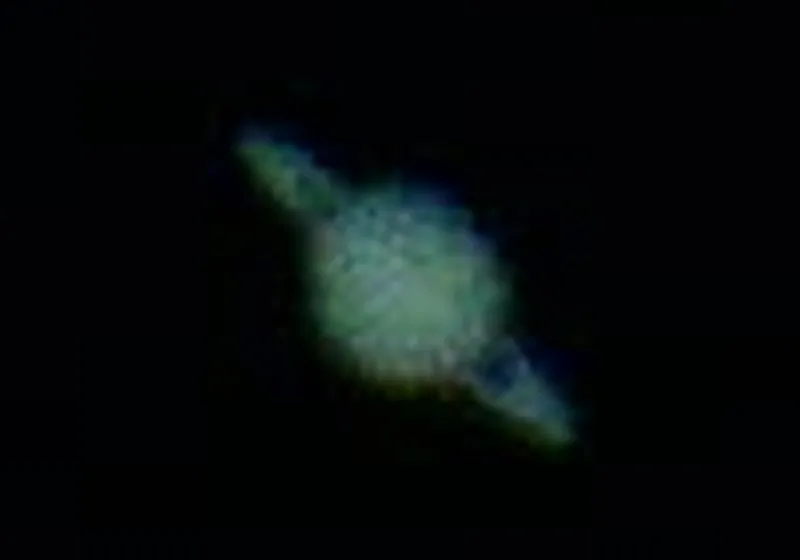
| 21:14 | 30 ms, peak 130/255, 1.2' left of centre, holding |
| 21:16:30 | focus score peaks at ~340 (Fit view) |
| 21:17 | I went past it - the score halves |
| 21:19 | cloud: at 30 ms Saturn is gone, at 1 s a dim blob |
| ~22:10 | back for another look: 1/13 of the clear-sky light |
What I got wrong
- I never pressed Record on Saturn. It was on target, tracked and nearly focused for five minutes. A rough SER at 30 ms would have been worth more than the focus I was chasing.
- I kept focusing through the cloud. The "wrong way" nudge at 21:19 was judged on a cloud-softened image. Once the light drops, stop touching the focuser.
- The alignment mixed two optical axes. The Moon reference came through the finder, the Saturn one through the Mak. Together they fitted a 4.5 deg tripod tilt that does not exist. The Moon reference was deleted; Saturn in the Mak is the only one.
The Moon, single fields
Eight runs at 1280 x 720, 30 s each, all at 30 fps with no drops.
| run | time | field | frames | GB |
|---|---|---|---|---|
| 000001 | 21:53 | the limb | 901 | 2.49 |
| 000002-4 | 21:56-21:58 | surface inside the limb | 901-902 | 2.49 each |
| 000005-7 | 22:22-22:24 | Tycho and its rays | 901-902 | 2.49 each |
| 000008 | 22:25 | recorded from the page | - | 2.49 |
Peaks sat at 177-204 out of 255 with nothing clipped, at 30 ms through thin cloud.
The whole disc
First attempt, 22:32, 6x4 at 30%: wrong in two ways. The go-to had put Tycho in the middle, not the Moon's centre - the only alignment reference was Saturn, 25 deg away, and a one-reference model is not good enough over that. The mosaic script assumes the Moon is centred when it starts, so the whole right-hand column and the top-right corner came out black while the disc spilled off the other side. And the script's own exposure search picked 44.8 ms, which blew the highlands to 255 once the cloud thinned. Deleted.
It was also refused twice before it ran at all: the residual check saw the 12 deg home error
as "the Moon is not centred". rig-ui now hands lunar-mosaic the alignment's bearing as
--az-frame-offset - and the first version had the sign backwards, doubling the error to 22
deg.
The correction came from the failed run itself. How lit each panel was put the Moon's centre about 12' lower in azimuth and 4.8' lower in altitude than the grid centre. One move of exactly that, then the same grid again at a fixed 28 ms.
Second attempt, 22:46: every panel where it should be.
lit     c0    c1    c2    c3
  r5    8%   45%   49%   11%
  r4   44%   95%  100%   48%
  r3   67%  100%  100%   54%
  r2   62%  100%  100%   50%
  r1   28%   78%   65%   13%
  r0    1%    9%    6%    0%
Limb inside the outer ring on every side, centre full, peaks 175-223 and nothing clipped.
| tonight | 22 September | |
|---|---|---|
| panels | 24 (6x4 at 30%) | 15 (5x3 at 30%) |
| gotos | all within 2" | - |
| Hugin control points | 438 inliers over 34 pairs | - |
| median CP residual | 2.3 px = 0.51" | 6.6 px = 1.46" |
| deviation from commanded | median 0.53', max 1.18' | - |
| gains | 0.85-1.18, 2 at the cap | 0.985-1.020 |
| sunlit disc captured | 100% | 88.2% |
Measured, not looked at. A circle fitted to the limb of the finished image, then the lit fraction around the rim: 94-100% everywhere except the upper-left arc, where it drops to about 60% - the unlit sliver a 95.6% Moon must have. Nothing is missing. The one visible flaw is faint horizontal streaking in the dark mare at upper left: stacking through cloud, and two panels that needed their gain at the 0.85/1.18 cap.
Processed from the page: stack-ser.py -> mosaic-hugin.py -> mosaic-final.py, about twelve
minutes. Output moon_moon_full.png, 7775 x 7486, in
AstroDMx_DATA/mosaic-2026-09-28-6x4-2246/.
Left for next time
- Recalibrate the SV205 transform on the Mak. Its 23 September calibration implies 0.31-0.33"/px against the measured 0.256. A tap-to-centre on the Moon moved the image 891 px for 561 predicted, and walked the limb clean out of the capture box.
- The finder has no transform. Its calibration failed under cloud (3.4 and 1.6"/px against 1.44 expected).
- The 1:1 view came up black with Saturn inside the area it should show. Not chased.
- Saturn still has no SER. Opposition is 4 October.
- The rig-ui changes are on the
rig-ui-searchbranch, not merged.