SESSION 6 · 09/26 · WORKED
Eight degrees of compass, a cloud of mosquitoes, and Venus in the last twenty minutes
Lost the first hour and a half to a pointing error I have been guessing at since 30 August and finally measured: 7.4 degrees of azimuth, which is Goolwa's magnetic declination. Two false trails, a mount that lost its place, and enough mosquitoes to drive me indoors twice. Then ten runs in twenty-three minutes and the sharpest Venus yet.
The afternoon
Asked at 16:44 what the best time to see Venus was. The answer was that I had already missed it: Venus peaked at 71 degrees at 14:45, which is the highest it gets all season, and by the time I asked it was down to 56 and falling. It was still a perfectly good daylight target — 42 degrees from the Sun, easy to keep behind a roofline — and I could not find it by eye. Focused on a distant hill, scanned above the Sun, nothing. Thin haze, probably.
A note on bearings, because I keep getting this wrong. Facing west from here, everything sets right to left. The Sun and planets cross the northern half of our sky, so as they go down they run from north, which is on my right, round to south, on my left. I keep expecting left to right, which is the northern hemisphere picture I grew up reading about. The mount was tracking correctly and I thought it was backwards.
The other thing I did not know: the AZ-GTe has no idea where it is. No GPS, no compass, no accelerometer, no level sensor. Two motor step counters and nothing else. Location and time come from the phone, orientation comes entirely from me putting the tube level and pointing north at switch-on, and everything after that is dead reckoning. There is no sensor anywhere in the system that could have caught what went wrong tonight.
Ninety minutes of black frames
From about 17:35 to 19:05 the camera showed nothing at all. Nothing. Uniform sky, dust donuts, no planet, at any focus, in any run.
Three separate things went wrong and each one hid the next.
The circular check. I read the mount's raw axis counts over the network and compared them to where Venus should be. They agreed to a few hundredths of a degree, which looked like proof the pointing was fine. It was not proof of anything. The mount's "home" is assumed to be tube level and true north, so working backward from the axis counts to a sky position assumes the alignment is right and then confirms it. What the match actually proved is that the mount was tracking at Venus's rate, which is the thing that works even when the alignment is several degrees out — exactly the point I made about goto versus tracking in the last entry, and I still fell for it.
The camera warm-up. Short grabs off the SV205 came back dark and flat. They were not dark because there was nothing there — the auto-exposure needs about thirty frames, call it a second of streaming, to ramp up. Anything shorter than that reads as a black frame whatever is in front of the telescope. That sent me hunting a focus problem for half an hour on evidence that was pure measurement artefact.
A sweep that never ran. Racked the focuser slowly through its entire travel while a 200-second capture was supposed to be recording. The capture had been chained behind a cleanup command that errored, so nothing at all was written. Three minutes of careful focusing against a recorder that was not running.
What finally settled it was seeing Venus naked eye at about 18:10, once the sky darkened enough. That killed the cloud theory. And by 18:23 the sky level in the camera was down to 7 of 255, dark enough that a badly defocused Venus would still have lifted the whole frame. A black frame at that point can only mean the light is not arriving.
Seven point four degrees
Then the mount moved on its own, or I fat-fingered something in the app. Between two reads five minutes apart it had gone 18.9 degrees down and 12.5 degrees east and was happily tracking at Venus's rate from the wrong place entirely.
I put it back by hand — arrows in the app, eye on the sky, Venus now bright enough to aim at directly — and then read the axes again. And there it was.
Centring Venus by hand required 7.4 degrees of azimuth and 0.9 degrees of altitude away from where the mount's own model put it. Magnetic declination at Goolwa is about 8 degrees east. That is the number. That is the entire reason the goto has missed every single time since 30 August.
I wrote this down as a possible cause on 11 September and did not test it. Tonight it is measured. Seven point four degrees is thirty-seven times the width of the camera's field, which is 0.2 by 0.13 degrees. There was never the slightest chance of the planet being in frame. Synced on Venus, and after that everything landed. See [[compass-north-is-not-true-north]].
The mosquitoes
Worth its own heading because it cost real time.
They were appalling. Goolwa in September, a few hundred metres from wetland, and they found me the moment the sun went down. Long sleeves, everything covered, and still getting eaten through the back of my hands while trying to work the focuser.
No Aeroguard in the house. So I sprayed myself with Glen 20, which is a surface disinfectant, and which — I now know — is mostly alcohol, does essentially nothing to a mosquito, and dries your skin out nicely. Do not do this. The Lower Murray mozzies carry Ross River, so this is not purely a comfort issue.
The other thing nobody warns you about: that can was going off within a couple of metres of an open Maksutov corrector plate. Aerosol overspray on a corrector is a horrible film to remove and I was lucky. Repellent and optics do not belong in the same arm's reach. Buy actual repellent. Rig a fan at the tripod next time — mozzies are weak fliers and even a small breeze keeps them off.
The runs
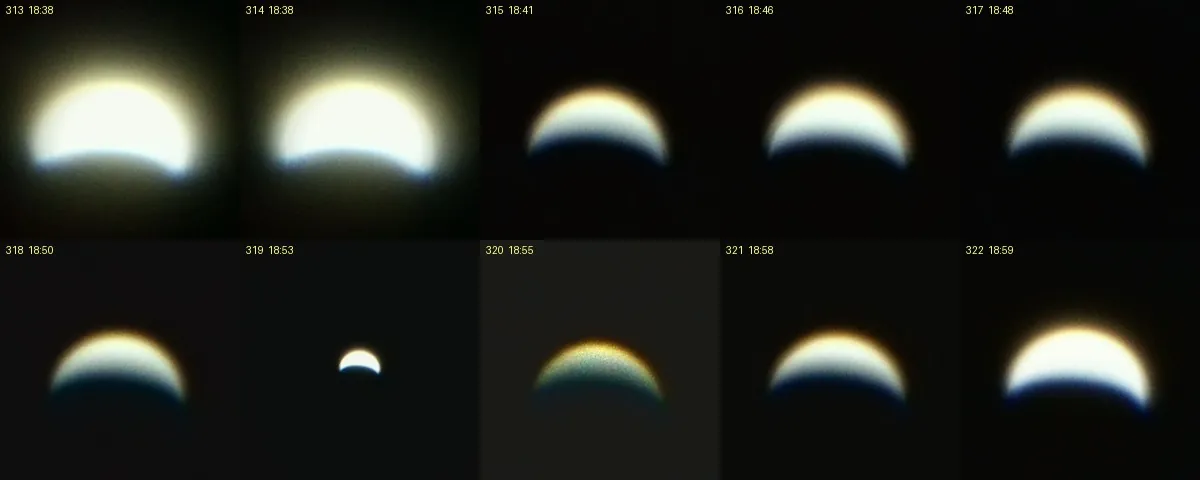
Ten runs between 18:38 and 19:01. Twenty-three minutes. 161 GB.
Venus tonight: 0.4692 AU away, 41.9 degrees from the Sun, phase angle 112.6 degrees, 30.8 per cent lit, 35.6 arcseconds across — which is 160 px at 0.222"/px. It was at 33.6 degrees altitude for the first run and dropping about three degrees every quarter hour.
| run | time | resolution | exposure | gamma | disc width | vs 35.6" |
|---|---|---|---|---|---|---|
| 000313 | 18:38 | 3264×2160 | 25 ms | 300 | 63.5" | +78% |
| 000314 | 18:38 | 3264×2160 | 25 ms | 300 | 61.1" | +72% |
| 000315 | 18:41 | 3264×2160 | 1 ms | 300 | 39.5" | +11% |
| 000316 | 18:46 | 3264×2160 | 9 ms | 300 | 42.6" | +20% |
| 000317 | 18:48 | 3264×2160 | 46 ms | 142 | 41.1" | +15% |
| 000318 | 18:50 | 3264×2160 | AUTO | 142 | 36.9" | +4% |
| 000319 | 18:53 | 800×600 | AUTO | 142 | 48.0" | +35% |
| 000320 | 18:55 | 3264×2160 | 1 ms | 142 | 31.5" | −12% |
| 000321 | 18:58 | 3264×2160 | 12 ms | 142 | 36.4" | +2% |
| 000322 | 18:59 | 3264×2160 | 87 ms | 142 | 38.9" | +9% |
Disc width is the focus metric here, and it is a good one. Venus is a crescent, and the cusps of a crescent span the full diameter of the planet. So the cusp-to-cusp width should come out at exactly 35.6 arcseconds no matter what the phase is. Anything wider is bloom, and bloom is defocus. It needs no reference star and no extra maths — the ephemeris tells you the answer in advance and the frame tells you how far off you are.
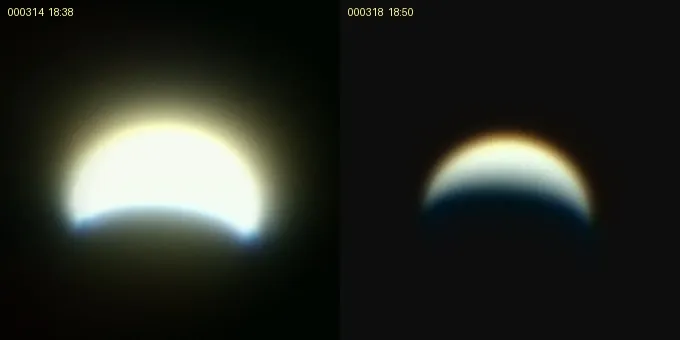
By that measure runs 313 and 314 were not slightly soft, they were 70 per cent oversized. The crescent read as roughly half lit instead of 31 per cent, because the glow spilled across the terminator and filled in the dark side. Both of those are the same fault.
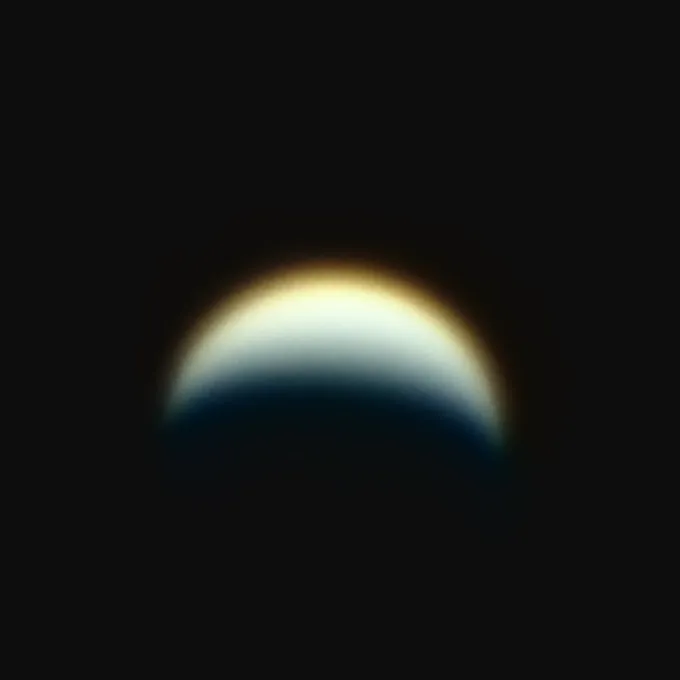
Run 000318 is the keeper: 36.9 arcseconds, four per cent over, which is as close as this scale and this seeing is going to get. Run 000321 is nearly as good at 36.4.
Run 000320 reads under size at 31.5, but that is a threshold artefact — the exposure had been dropped to 1 ms, peak brightness was only 140 of 255, and the dim limb simply fell below the cutoff. Underexposed, not small.
The 800×600 experiment, which did not do what I expected
Shot run 000319 at 800×600 expecting a cropped region of interest: same image scale, far higher frame rate, tiny files. One of those three came true.
| 3264×2160 | 800×600 | |
|---|---|---|
| file size, 1000 frames | 21.15 GB | 1.44 GB |
| frame rate | 15.12 fps | 15.12 fps |
| Venus across | 166 px | 53 px |
The frame rate did not move at all. And the planet came out a third of the size in pixels, which means the camera is not cropping the sensor, it is downscaling the whole field. So the mode throws away exactly the resolution I am trying to record, gains nothing in speed, and only saves disk. That is a bad trade for planetary work. If AstroDMx has a true crop-style ROI it is somewhere I have not found; the resolution dropdown is not it. See [[lower-resolution-is-not-a-roi]].
The 15.12 fps ceiling held across every run and every exposure except the 87 ms one, which fell to 11.5. The camera is streaming at a fixed rate and nothing I changed touched it.
Stacking, properly, an hour later
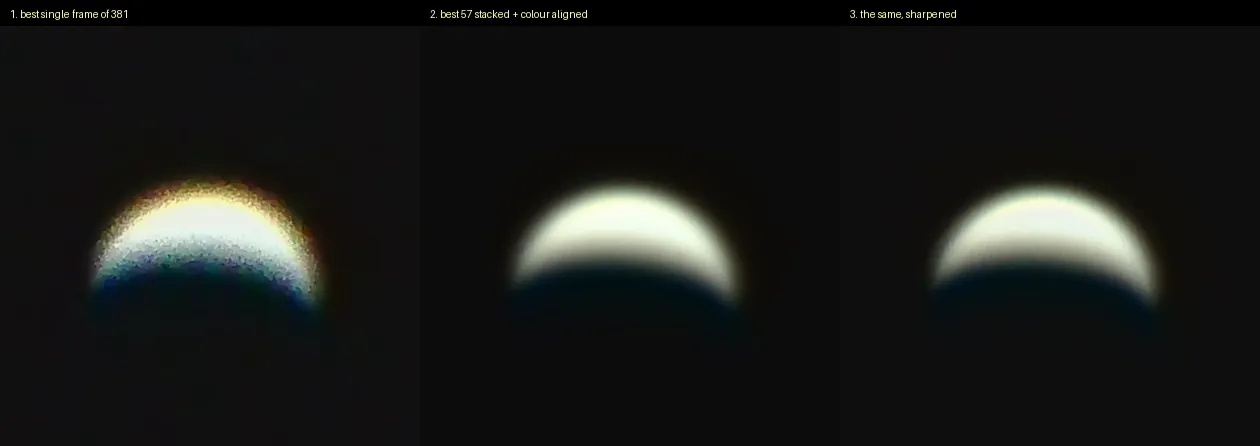
Opened the SERs in Siril afterwards and thought they looked terrible. Made the identical mistake to last night, one day after writing [[stacking-is-selection-then-sharpening]] about making it: Siril shows one raw frame at a time, and one raw frame of a planet at 0.222"/px carries the full sensor noise and one random instant of moving air. It cannot look good. Ten runs is about 9,100 frames and not one of them is meant to be looked at on its own.
Ran the three steps properly on the four usable runs — select the sharpest 15 per cent, align to sub-pixel and average, then align the colour channels and sharpen.
The dispersion is now a number rather than an impression. Measuring the red and blue images of the planet against green in each stack:
| run | time | R–B separation | altitude | |
|---|---|---|---|---|
| 000318 | 18:50 | 5.18 px | 1.15" | 33° |
| 000320 | 18:55 | 7.09 px | 1.57" | 32° |
| 000321 | 18:58 | 5.46 px | 1.21" | 32° |
| 000322 | 18:59 | 5.69 px | 1.26" | 31° |
Last night it was 6.6 px, 1.5", at 27 degrees. Tonight at 33 degrees it is 5.2 px, and it creeps up run by run as Venus falls. That is [[altitude-beats-everything]] showing up as a measurement three nights running.
Run 000320 is the outlier at 7.09 and I do not trust it — it is the 1 ms underexposed run, and a dim limb moves the centroid the measurement depends on.
Shifting the channels back onto green removes the fringing completely. No ADC, no new hardware, just three numbers and a translation. It cannot recover detail smeared within each channel, but the orange-and-blue rim is gone.
PlanetarySystemStacker turns out to be installed already at ~/.local/bin/, from the
11 September list. Siril is here too, as a flatpak, version 1.4.4 — fine for the final
sharpening, wrong tool for the stacking. Use PSS for selection and alignment, Siril for the
last step.
What I got wrong
- Trusted a check that assumed its own answer. The axis-count comparison could only ever agree with itself. Any alignment check has to come from outside the mount's own model.
- Read black frames as an empty sky without ever asking whether the camera had settled. Thirty frames. One second. It would have saved half an hour.
- Ran a focus sweep against a recorder that was not recording and lost three careful minutes to it.
- Called run 000319 truncated on file size alone, because 1.4 GB looked like an aborted 21 GB run. It was a complete 1000-frame run in a smaller mode. Check the header, not the size.
- Assumed a smaller capture size meant a faster one. The log says otherwise.
- Judged the runs raw in Siril again, one day after writing up why that is meaningless. Knowing a lesson and remembering it at the eyepiece are different skills.
- Still had not fixed anything on the 11 September list before starting: gamma was at 300, in-camera sharpness at 50, white balance on AUTO, object name unset. Gamma came down to 142 mid-session and never reached 100. The other three never moved. Third session running for the object name — see [[object-name-decides-the-archive]].
Results
Success, on twenty minutes of a four-hour night. The sharpest Venus yet: 36.9 arcseconds against a predicted 35.6, a clean terminator, and a crescent that finally looks like the phase the ephemeris says it is.
Dispersion again, orange along the top limb and blue along the bottom, at 33 degrees altitude. Same effect as 11 September, less of it because I was nine degrees higher. Still fixable in the stacker by aligning the channels, still properly fixable only with an ADC. [[altitude-beats-everything]] keeps being the most useful thing in this log.
Drift is real over a minute. 204 px in 67 seconds, which is 41 arcseconds a minute. Fine on a full frame, would walk out of a small crop in a couple of minutes.
Exposure went on AUTO for the two best runs, which is not a setting I would have chosen and I cannot tell from the log what it actually landed on. With [[no-gain-control]] the exposure is the only lever, so this is worth pinning down manually next time rather than getting lucky.
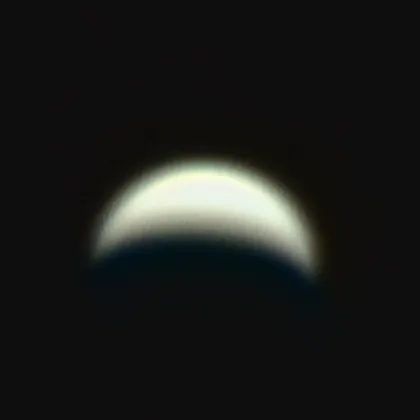
Processed stacks saved to AstroDMx_DATA/2026-09-12/keepers/: runs 318, 320, 321 and 322
each as best-single-frame, stack, and finished image, plus the montages in this entry. Ten
SER runs still on the laptop, 161 GB of them, 211 GB free. Runs 313 to 317 are the
defocused ones and are about 108 GB between them — nothing in them is worth stacking.
To fix
Everything still outstanding from 11 September, plus:
- [ ] Set true north, not compass north. 8 degrees east at Goolwa. Or skip it: point anywhere, find something bright by hand, sync, done.
- [ ] Sync on the first object of the night, every night. It costs thirty seconds and it was worth ninety minutes tonight.
- [ ] Object Name →
Venus. Found where it lives at the very end: it is the capture filename prefix, next to the output path, not a separate observing field. - [ ] Gamma 100, sharpness 0, WB off auto. Confirm in the log afterwards.
- [ ] Exposure manual, 3–10 ms, peak 150–200 of 255.
- [ ] Let the camera stream for a second before trusting anything on screen.
- [ ] Find out whether AstroDMx can do a real sensor crop. If not, full frame and accept 21 GB per run, or shoot shorter runs.
- [ ] Check disc width against the ephemeris while still at the scope. The number is known in advance; there is no reason to discover the focus was wrong the next day.
- [ ] Buy repellent. Keep it away from the optics.
- [ ] Fan at the tripod.
- [ ] Shoot at sunset. 18:00 was 42 degrees. I started at 18:38 at 33 and finished at 30.
What's next
- Venus weekly through October. The crescent thins and grows from 35" toward 60" at inferior conjunction on 24 October. Tonight is the second data point in that sequence.
- Saturn, opposition 4 October, rings near edge-on.
- Moon back from 14 September, first quarter around the 18th, high and easy.
- A Bahtinov mask would have turned tonight's eight-run focus hunt into one adjustment. It is the cheapest fix on the whole list.