SESSION 22 · 10/26 · WORKED
The setting Moon from the back yard
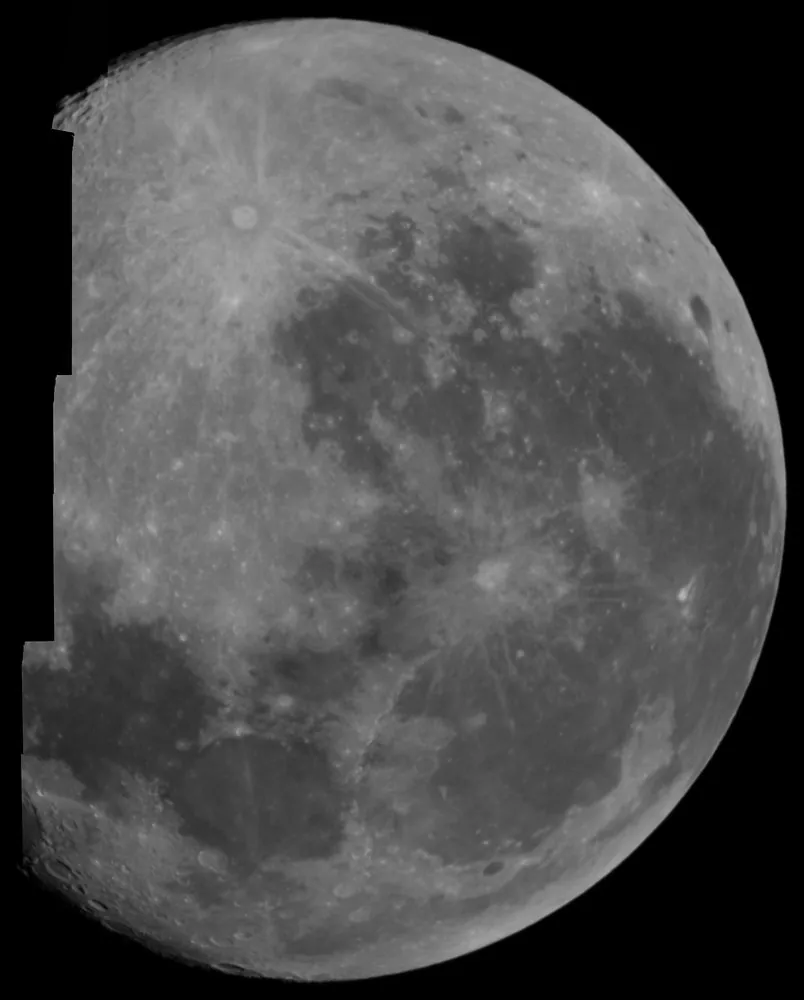
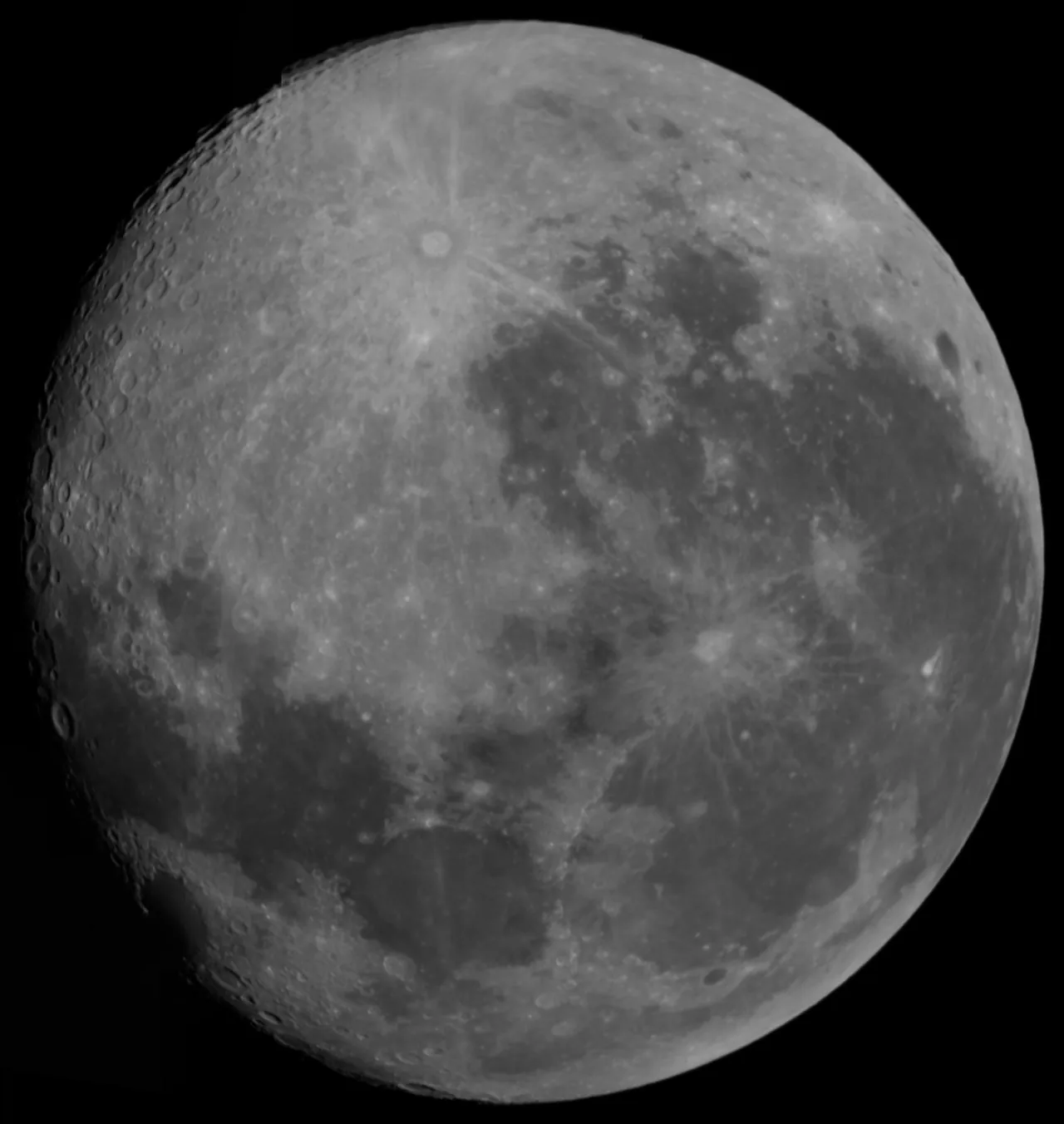
Two nights in one entry. 26/10 clouded out. On 27/10 the Moon came up behind the verandah and into cloud, and an 8x5 at 23:00 got the lower two thirds before power lines blacked it out. At dawn, with the scope moved to the back yard, a grid at 12-15 degrees, a column down the left limb and one extra panel at the top stitched into a complete waning Moon.
127 Mak on the AZ-GTi, on the mount's hotspot, SV205 in the Mak. rig-ui on the laptop, Claude driving it through rig.py. Moon about 98% lit and waning, rising around 21:20. Front yard in the evening, back yard at dawn. Written up the morning after, 28 October.
26/10, clouded out
The night before was set up and centred, then lost to cloud. The Moon was low and dim through it and the limb fit refused every frame. Called just before 23:00. One useful thing came out of it: a calibration of which way the picture moves for each axis, taken in a clear gap.
21:00 to 23:00, the verandah and the cloud
Saturn was up at 39 degrees while we waited, but the Moon rose first in the finder. It came up behind the verandah: a straight dark edge across the disc, then a post. Then cloud.
The limb fit worked when the frame was clean. The two-limb hop did not: it jumps a whole Moon's width to the far limb, the GTi under-moves and drifts, and twice it landed in empty sky. I watched one of the hops sail straight past the Moon. Single limb fit, one move, then re-align was what worked.
The first launch stopped before moving: the motors were never initialised after power-on. rig-ui's own moves work without it, but lunar-mosaic checks and refuses. Claude sent the start-up command to both axes; nothing moved.
22:59, two thirds
| start | grid | frames | exposure | panels | result |
|---|---|---|---|---|---|
| 22:59 | 8x5 | 120 | 18 ms | 40 | lower 2/3 good, top black |
| 23:41 | 8x5 | 120 | 18 ms | 2 | aborted, camera set as finder, then cloud |
| 05:15 | 8x5 | 120 | 18 ms | 14 | bottom row only, then the trees |
| 05:27 | 8x5 | 120 | 18 ms | 40 | the keeper, one column right and a bit low |
| 05:39 | 6x1 | 120 | 18 ms | 3 | left column, went the wrong way |
| 05:46 | 8x1 | 120 | 18 ms | 8 | left column, right way |
| 05:53 | single | 120 | 18 ms | 1 | one panel above the column, aimed by hand |
The 22:59 grid peaked at 190-240 on the bottom four rows, then faded and went black from 23:08. That was power lines, not cloud. I moved the tripod, which made the alignment worthless. The 23:41 restart thought the camera was in the finder (a 133-arcminute frame), and stopping it also stopped tracking. More cloud, and nothing more until dawn.
05:15, the trees, then the back yard
Restarted at 05:11 with the Moon at 17 degrees and setting. The 05:15 grid got its bottom row before the Moon went behind the trees. I carried the scope to the back yard: no trees, no buildings to the west.
lunar-mosaic won't go below 15 degrees. The Moon was at 14.5, so Claude lowered the floor to 10 for each of these runs and put it back after. The 05:27 grid ran clean: every panel with Moon in it peaked 185-231, nothing clipped. The best exposure of the two nights, and at 18 ms, not 13: a low Moon through four or five times as much air is redder and dimmer.
It landed one column to the right: column c4 was all sky and the Moon ran off past c0.
The left column
The first make-up column went the wrong way, into the sky beside c4. The grid shift in lunar-mosaic runs opposite to how it reads: a positive azimuth shift moves the grid toward c0. The second try refused because the Moon had drifted off centre. I re-centred by hand and the 05:46 column ran, then I aimed one more panel by hand above its top and Claude recorded it.
The camera settings were the same throughout. The column came out dimmer (medians 50-80 against
75-125) because the Moon was lower and the column is mostly limb, which is darker anyway.
mosaic-blend.py --cloud evened it out.
Stitching
The first stitch left the whole left column out: its panels had no matches with the main grid at all, only six with the extra top panel. The solver needs fifteen to trust a link. Claude re-ran it accepting five. The six were real: the column dropped into place and the disc was complete, 34 panels, 8759 x 9248. A short stretch of the lower left limb is a little dark where nothing quite overlapped.
It's softer than 25/10. At 12-15 degrees the seeing smears the fine detail and no amount of stacking brings it back. A few panels drifted 300 pixels during their own capture.
What I got wrong
- Set up in the front yard. The verandah, the power lines and the trees each took a turn. The back yard has a clear western sky.
- Moved the tripod mid-session and had to start the alignment again.
What the software got wrong
- The two-limb hop is too big a jump for the GTi. One limb, one move, re-align.
- The limb fit fails in twilight: the sky is brighter than its fixed threshold. Hand-centring was better at dawn.
- The grid shift sign is backwards from what it looks like.
- A refused start-up check sends an emergency stop, which kills tracking.
- The 15-degree floor is hard-coded. It should be an option.
rig recordmay reset the exposure. Set 18 ms, read 14.7 after.
Left for next time
- Back yard for a low western Moon. Front yard only when it's high.
- 18 ms for a full Moon below 15 degrees, 13-14 ms higher up.
- The waning Moon rises about an hour later each night. The next mosaic window is a pre-dawn one.
- A spare panel between runs can link them. If a run won't join, look for a panel that touches both and try a lower match threshold.