SESSION 23 · 10/26 · WORKED
First light for the ZWO
First night with the ZWO ASI662MC, on the 127 Mak with the SV205 moved to the finder. Saturn came out soft in sixteen recordings, which I blamed on my focus; the numbers said seeing. After midnight, five 7x4 lunar mosaics: one from auto exposure, one lost to dew, two that sat too low, and one keeper. Then the Moon went behind the house.
127 Mak on the AZ-GTi, on the mount's hotspot. ZWO ASI662MC in the Mak, SV205 in the finder. rig-ui on the laptop, Claude driving it. Saturn in the evening, a waning Moon about 83% lit after 02:30. Front yard. Written up on 31 October.
Getting going
The altitude limit blocked every move. The mount's encoders read 0 degrees altitude at power-on, so rig-ui thought the scope was pointing at the horizon and refused to go lower. Claude stopped rig-ui, wrote Saturn's position into the encoder counts, and restarted it.
The ZWO showed nothing with Saturn centred in the SV205. The finder and the Mak weren't pointing the same way. Once Saturn was found in the ZWO by hand, Claude measured where the Mak points in the finder's picture (the boresight) and saved it, and from then on centring in the finder put things in the ZWO. The dew shield, when it went on later, moved the Mak about 6.5 arcminutes above that point.
20:53 to 21:14, Saturn
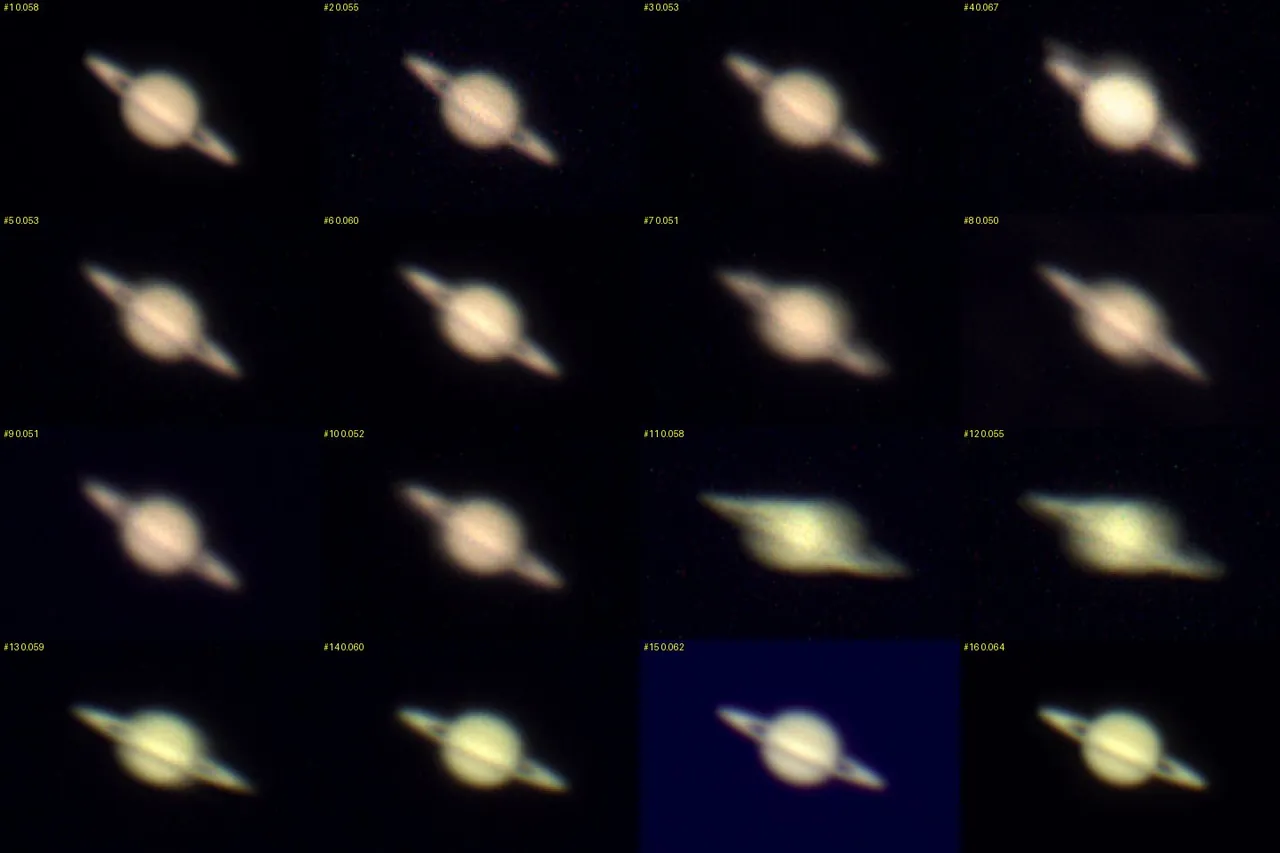
Sixteen recordings at full frame, 1920x1080. They all came out soft, and I thought it was focus. I had watched the focus score and turned the knob until it would go no higher, on both cameras, and the difference between a bad focus and an OK one was a fraction of a turn.
Claude measured the recordings frame by frame the next morning:
| measure | result |
|---|---|
| best 10% of frames against the median | only about 5% sharper |
| width of Saturn's edge | about 8 arcsec in every recording, first to last |
| image jitter, frame to frame | 1.6 to 2.6 arcsec rms |
| seeing that implies | about 3 arcsec or worse |
Every frame was equally soft, and that is seeing, not focus. A bad focus would leave some recordings sharper than others; a steady night would leave some frames sharper than others. Neither happened. The 127 resolves about 1.1 arcsec. The air was three times worse, and Saturn was only 35 to 45 degrees up, soon after setup.
The IR-cut filter that came with the camera went on before #11. Red dropped from 1.17 of green to 1.00 and blue from 0.80 to 0.68, with the brightness about the same: it was blocking infrared, as it should. #11 and #12 are smeared sideways, probably from knocking the scope fitting it. #15 is ten times dimmer than its neighbours and nearly colourless, which looks like an exposure slip rather than the filter.
The Saturn reprocess
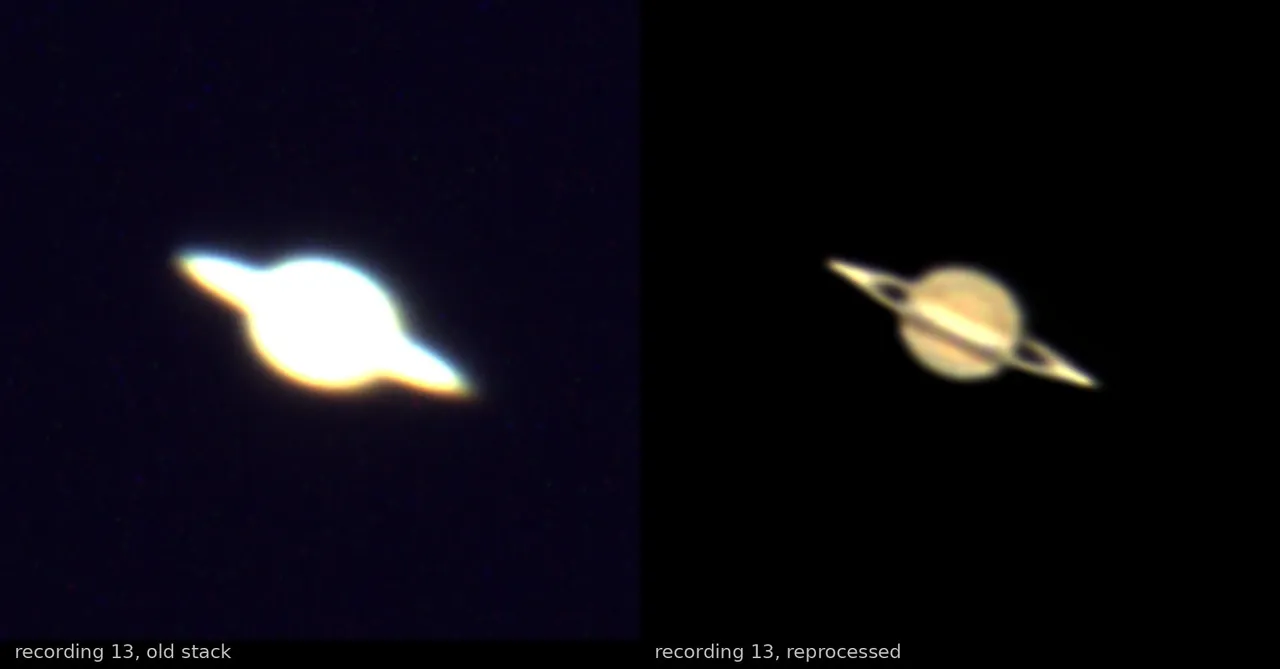
The old stacks were overexposed white blobs with blue and red fringes. Two days later Claude wrote a new planetary stacker and processing chain and ran #13, #14 and #16 through it. The result is in the before-and-after above: the ring-globe gap on both sides, the ring shadow across the globe, a darker band and darker polar region. All three show the same features, so they are real. How it was done is in [[the-detail-was-in-the-recording]].
It is still nowhere near the Facebook pictures from 8-inch and 14-inch scopes. That is aperture, and [[diffraction-is-the-real-ceiling]] already said so.
After 02:30, the Moon
| start | grid | frames | exposure | panels | result |
|---|---|---|---|---|---|
| 02:54 | disc | 60 | auto | 0 | aborted, the GTi's backlash broke the orientation moves |
| 02:56 | 7x4 fixed | 60 | auto | 28 | complete, overexposed at the bright limb, tile steps |
| 03:23 | 7x4 | 200 | 7.1 ms | 28 | dew on the corrector |
| 03:41 | 7x4 | 200 | 4.5 ms | 28 | too low on the disc |
| 03:47 | 7x4 | 200 | 4.5 ms | 28 | still too low |
| 03:54 | 7x4 | 200 | 4.5 ms | 28 | the keeper, grid shifted up 0.108 deg |
| 04:17 | 7x4 | 200 | 4.5 ms | 16 | aborted at the Moon's transit |
| 04:24 | 7x4 | 200 | 4.5 ms | 0 | refused, the Moon was behind the house |
Gain 242 from 03:41. The alignment was a mess before the first grid: points from Saturn and the Moon mixed into one model gave a 32-degree tilt. Clearing it and aligning on the Moon alone fixed it. The limb fit walked the limb out of the ZWO's small field and couldn't calibrate, so centring was done in the finder instead, to under one arcminute.
Dew got the 03:23 run before I had the shield on. The two low runs were the dew shield: it tipped the Mak's pointing 6.5 arcmin above where the finder thought it was. The fix was to shift the grid by the same amount, and the 03:54 run sat on the disc.
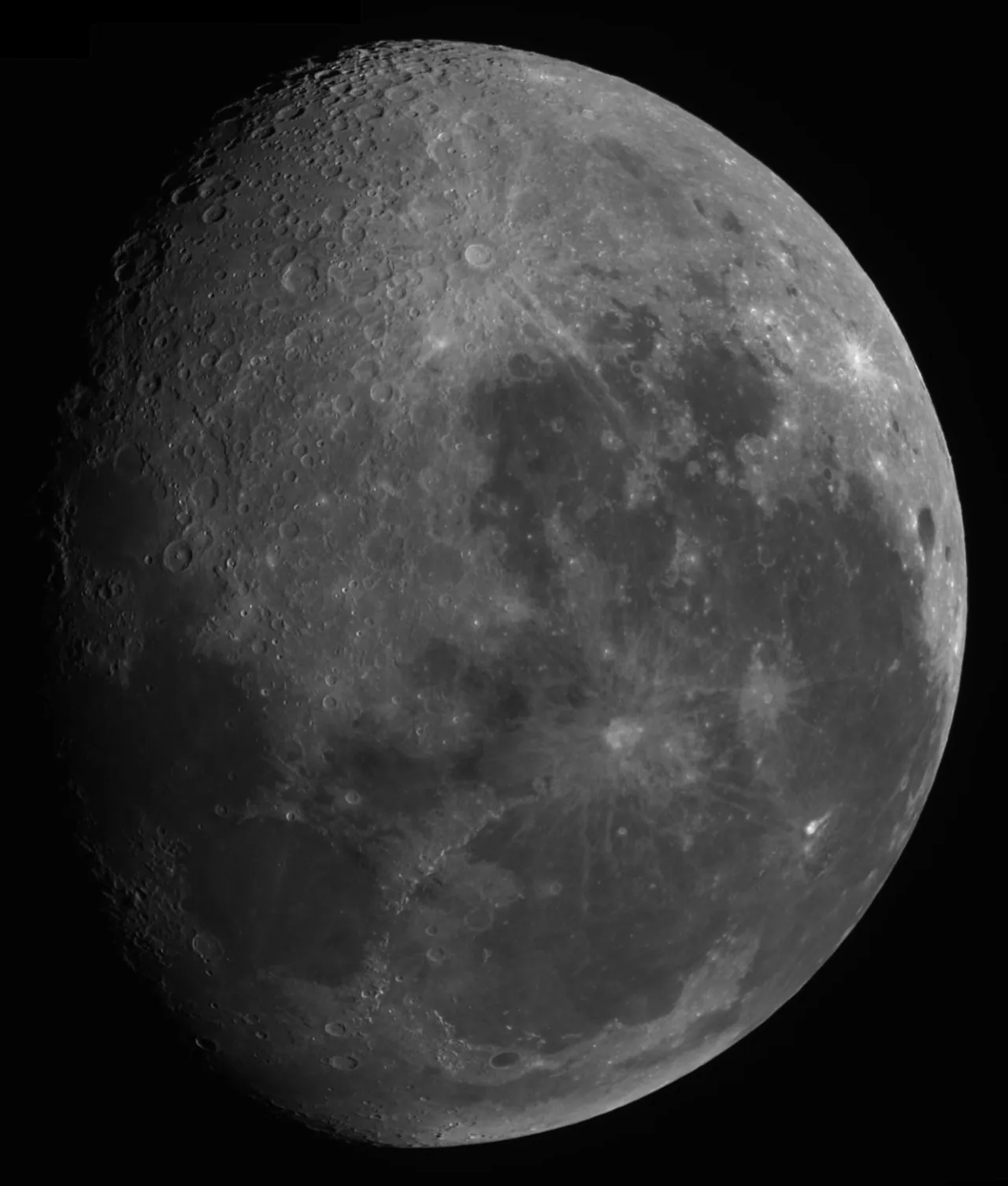
The keeper is clean: no clipping, Tycho's rays and Aristarchus intact, tile brightness corrections all within 2%. 23 small gaps of 57 px were filled in rather than shot. At full size it is soft, because the Moon was about 25 degrees up.
The first grid, at 02:56, is a keeper too, but it shows the tiles: steps in brightness on the Moon and grey rectangles in the sky, which I blacked out afterwards.
What I got wrong
- Blamed my focus. It was the air. The focus score has a broad flat top in bad seeing, which is why getting it to maximum felt like nothing changed.
- Put the dew shield on after the dew, not before.
What the software got wrong
- The 04:17 run aborted at transit. The Moon crossing due north asked for a 324-degree azimuth move, which the safety cap refused. It should have been a 36-degree move the other way. Not fixed yet.
- The centring loop centred on noise. With the Moon behind the house it measured an empty finder frame and moved the mount 1.1 degrees. It needs to check there is a lit Moon in the frame before it moves. The mosaic's own pre-check caught it.
- The disc mode needs small reliable moves, which the GTi doesn't make. Fixed grid works.
Left for next time
- Saturn near its highest, with the tube cooled an hour, and a small region of interest for a higher frame rate. Recordings of 60 to 90 seconds.
- Dew shield on at setup, and a heater strap.
- Measure the boresight with the dew shield on.
- A motor focuser would take my hands off the scope and let rig-ui autofocus.