SESSION 24 · 11/26 · WORKED
A Saturn worth keeping
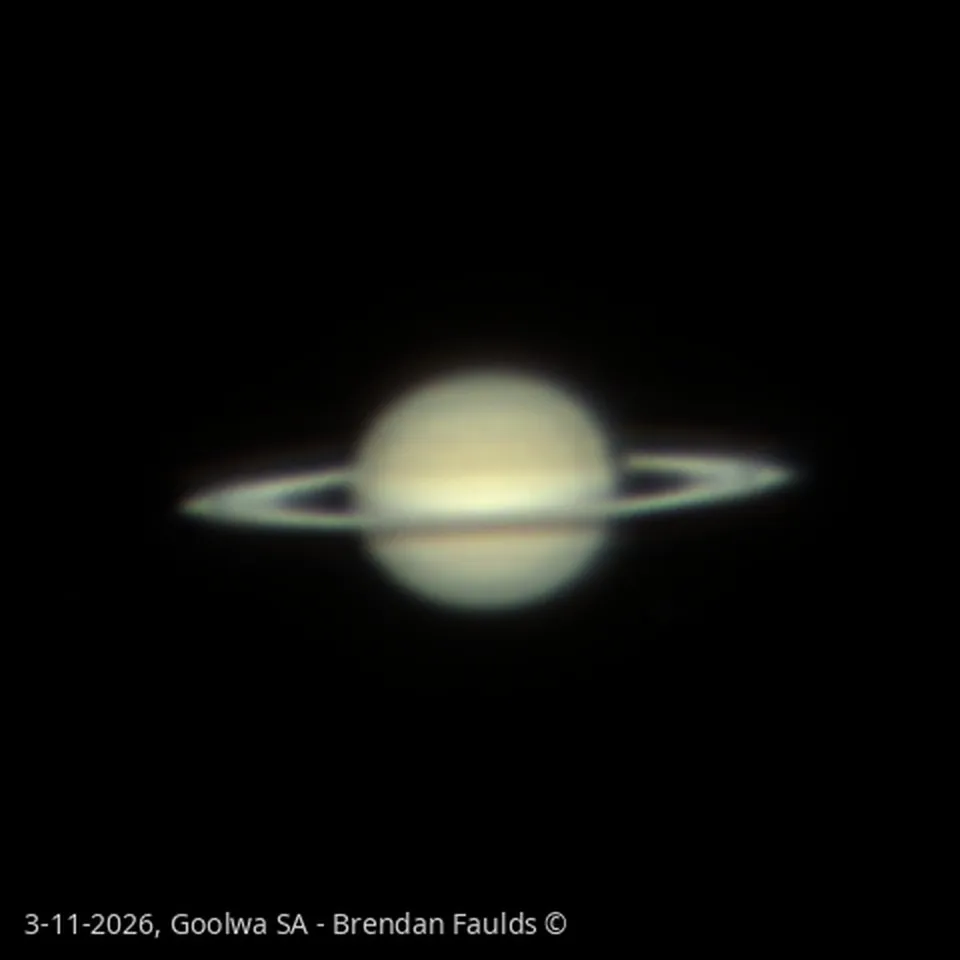
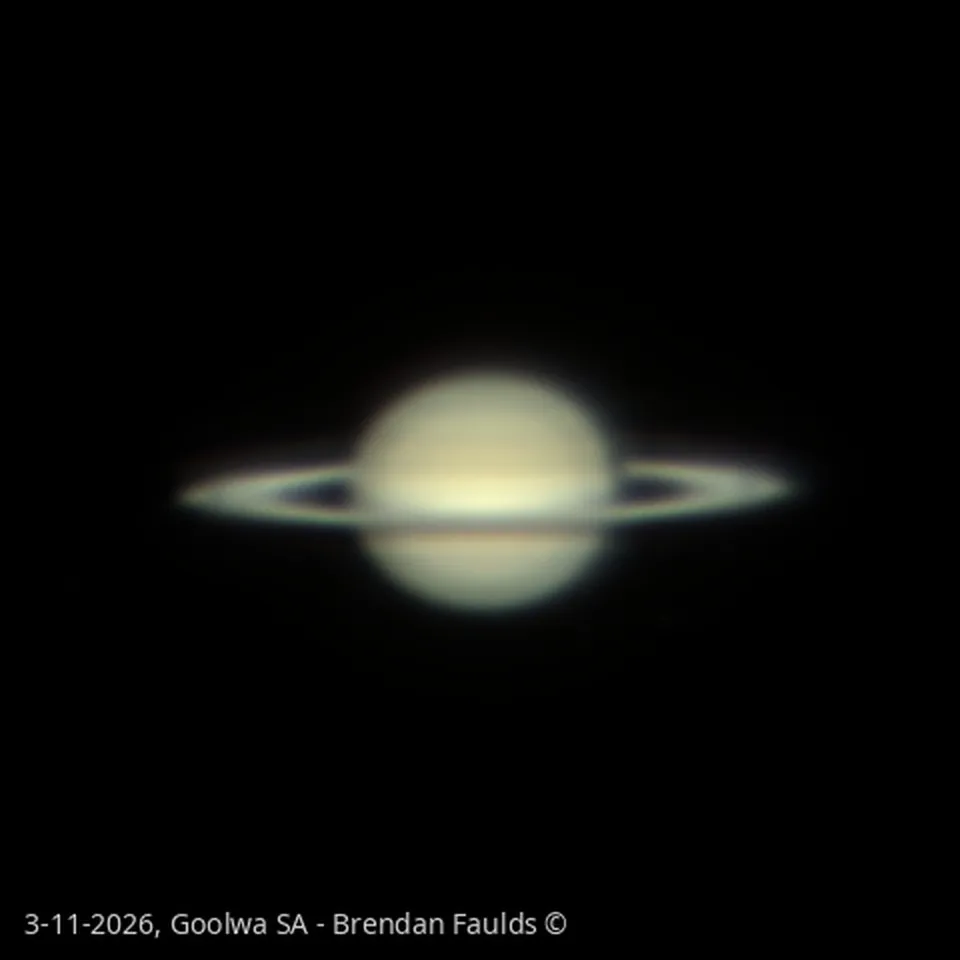
Saturn on the 127 with the ZWO, at 20 ms and gain 335, near its highest. The planet drifted out of the frame all night even with tracking on, and the stacker had to chase it. Twenty-four recordings, three of them full-frame by mistake, then cloud. The best six minutes gave a Saturn with the ring gap, the ring shadow and a belt, and it is the first picture with my name on it.
127 Mak on the AZ-GTi, on the mount's hotspot. ZWO ASI662MC in the Mak, SV205 in the finder. rig-ui on the laptop, Claude driving it from the phone. Saturn about 50 degrees up and climbing to its highest. Front yard. Cloud at 23:00. Written up on 4 November.
Getting going
Scope horizontal and roughly north, one goto. Claude started rig-ui, slewed to Saturn from the home position, and I walked it the rest of the way with the finder. Saturn in the Mak, focused by hand on the score, then the question of what to set.
20 ms and gain 335. That put the green channel's brightest pixels at about 190 of 255, nothing clipped, and the camera ran at 50 frames a second in a 640 x 480 window. 40 ms was visibly softer. 290 ms, which I tried first, was useless. The Balance button would have got this wrong: it measures the brightest 0.5% of the whole picture, and for a planet that is sky, so it would have pushed Saturn to white. Fixed afterwards to measure the planet.
22:08 to 23:05, Saturn
| run | start | size | exposure | length | frames | note |
|---|---|---|---|---|---|---|
| 1 | 22:08 | 640 x 480 | 290 ms | 200 s | 446 | test, useless |
| 2 | 22:16 | 1920 x 1080 | 20 ms | 100 s | 4,977 | full frame by mistake, 10 GB |
| 3 | 22:22 | 1920 x 1080 | 24 ms | 50 s | 2,116 | full frame, in the keeper |
| 4 | 22:24 | 640 x 480 | 24 ms | 180 s | 7,608 | in the keeper |
| 5 | 22:28 | 1920 x 1080 | 24 ms | 180 s | 7,610 | full frame, 16 GB, in the keeper |
| 6 | 22:32 | 640 x 480 | 15 ms | 60 s | 4,012 | sharpest single run |
| 7 to 20 | 22:34 to 22:49 | mixed | 40 ms | 30 to 60 s | 175 to 1,485 | softer at 40 ms |
| 21 to 24 | 22:56 to 23:05 | 640 x 480 | 189 ms | 180 s | 392 to 955 | thin cloud, then none |
Gain 335 to run 6, 287 from run 7. Runs 9 to 15 were a walk through the record sizes, 800 x 600 and 1280 x 720 and full frame, thirty seconds each. By 22:56 the exposure had gone to 189 ms and the planet was going in and out of cloud; 22 and 23 have nothing in them. I went inside.
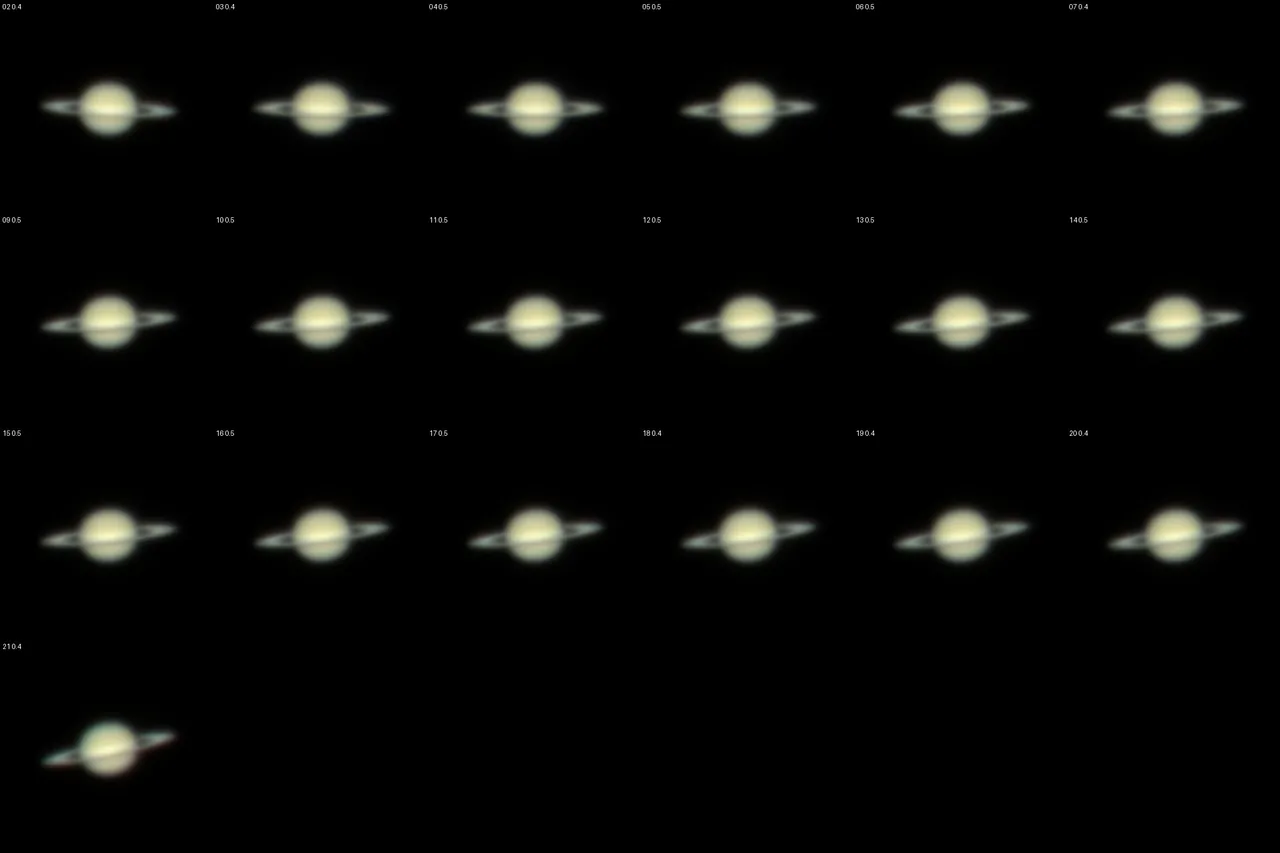
Saturn drifted the whole time, with tracking on. About a pixel a second, steady, no jumps when the rates refreshed. Claude checked the next day: both motors ran within 0.6% of what they were told. The rates were wrong, not the motors. Two reasons:
- One star is not an alignment. I had aligned on Saturn alone. With one point the model cannot know how far the mount is from level, and the rates it works out are off by a steady amount. A second alignment on a star 40 to 60 degrees away fixes it, and I did not do one.
- The altitude motor was parked. Near its highest Saturn climbs slowly, 0.8 arcsec a second that night, and the software treated anything under 1 arcsec a second as zero and stopped the axis. Two pixels a second on this camera. The floor is now 0.2 and slow rates are allowed to run unchecked.
The processing
The Moon stacker smeared Saturn across the drift, so Claude wrote a planet one: find the planet in every frame and crop around it first, then score, keep the sharpest quarter, align to a fraction of a pixel, average. Then the chain from [[the-detail-was-in-the-recording]]: red and blue lined up on green, white balance on the rings but only half way so Saturn keeps its cream, three times up, forty rounds of deconvolution, a light sharpen.
| measure | result |
|---|---|
| recordings stacked | 21 of 24 |
| sharpness, first run to last | 0.41 to 0.51, no trend |
| keeper | runs 3 + 4 + 5, 4,333 frames of 17,334 |
| runner-up | run 6 alone, 1,003 of 4,012 |
| Saturn's rotation across the six minutes | about a pixel at the limb |
The seeing was even all night, so the ranking was decided by frame count. Six minutes of neighbouring runs beat the sharpest single one. The ring gap is there on both sides, the ring shadow on the globe, the belt, the darker pole. Not the Cassini division; see [[diffraction-is-the-real-ceiling]].
The caption. From this night on every keeper carries the date, Goolwa SA, my name and the copyright in the corner, put there by the processing itself.
What I got wrong
- Left the record size at full frame for runs 2, 3 and 5. Thirty of the night's sixty gigabytes, for the same planet in the middle. Set 640 x 480 before the first run.
- Only one alignment point, so the tracking was never going to hold.
- Went to 40 ms after the good runs. The 20 ms ones are the keepers.
What the software got wrong
- Balance measured the sky, not the planet. Fixed: it steers on the brightest real pixels.
- The altitude floor parked the axis before transit. Fixed, 0.2 arcsec a second.
- The Moon stacker cannot follow a drifting planet. Replaced by the planet stacker.
- A one-point model does not warn that it cannot fit the tilt. It should.
Afterwards
All 60 GB of recordings deleted once the stacks and finals were on the Xeon and the Mac, checksummed. The stacks themselves are 8 MB.
Left for next time
- Two alignment points: Saturn, then Achernar or Fomalhaut.
- 640 x 480 from the first run, 20 ms, gain 335, three minutes each.
- Try the Balance button on a planet now that it measures the right thing.
- A motor focuser, still.