SESSION 25 · 11/26 · PARTLY WORKED
Saturn through poor air
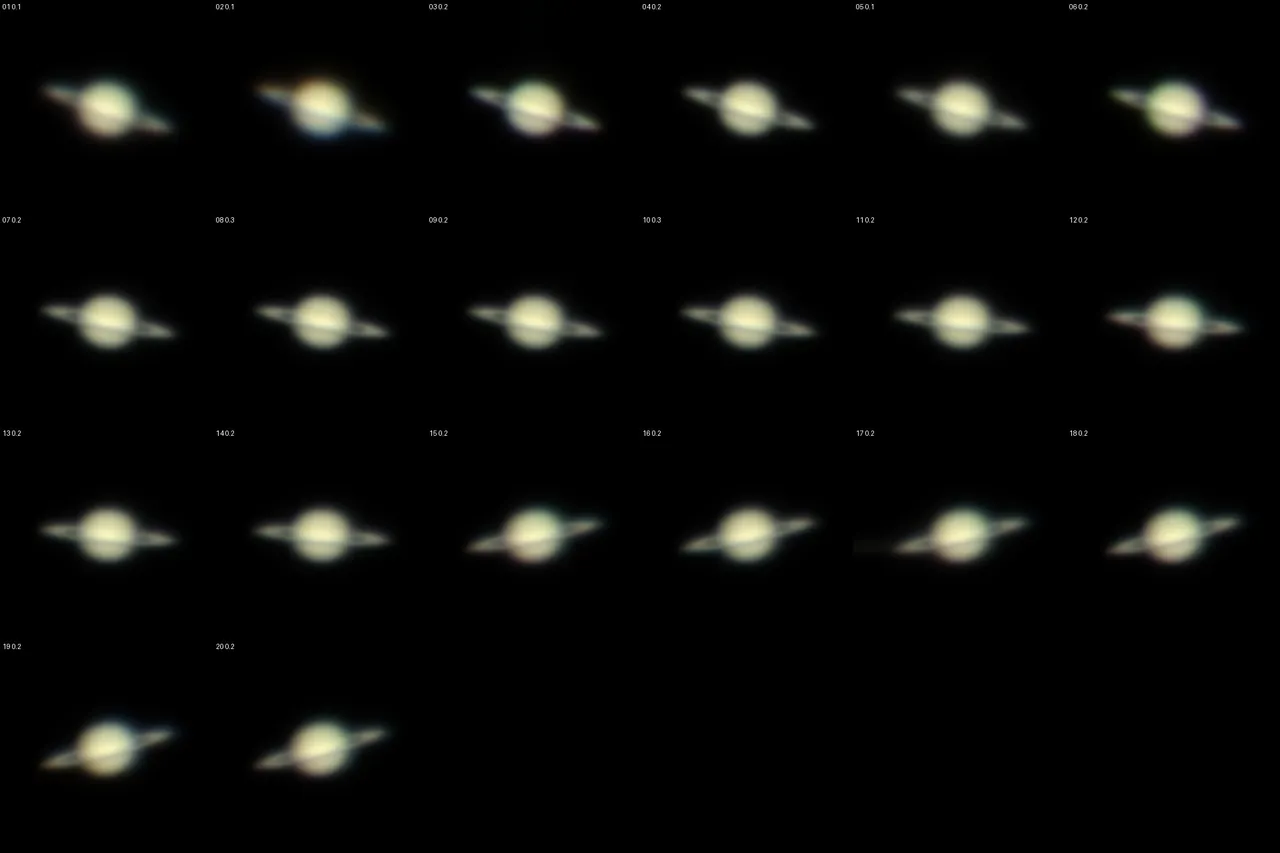
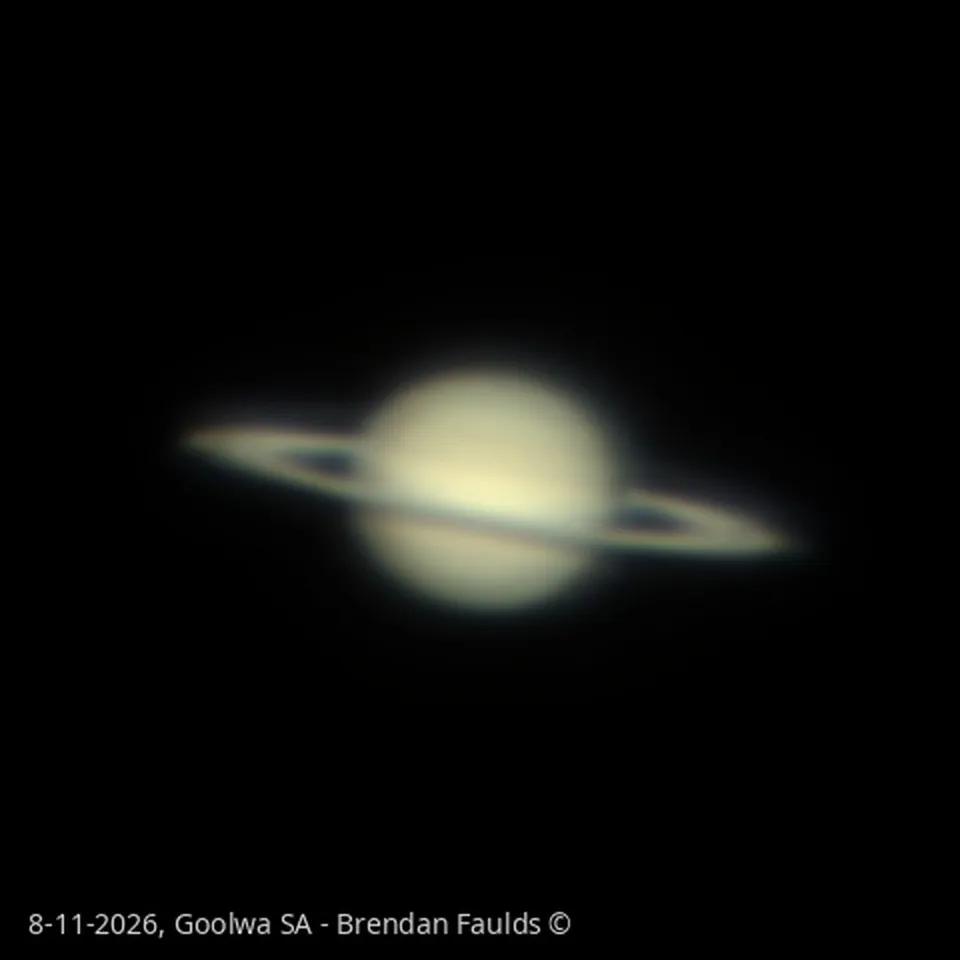
Back on Saturn with the 127 and the ZWO, same settings as the good night. The goto would not go anywhere without an alignment, the finder was pointing somewhere other than the Mak, and the tracking died when Saturn crossed the meridian. All fixed by the end. Twenty recordings and a second alignment star, Diphda, which halved the drift. The best picture is soft. I refocused and nothing changed: it was the air.
127 Mak on the AZ-GTi, on the mount's hotspot. ZWO ASI662MC in the Mak, SV205 in the finder. rig-ui on the laptop, Claude driving it. Saturn from 44 degrees up in the north-east to 53 at the meridian. Written up on 9 November.
Getting going, 20:40
Cameras plugged in after rig-ui was started, so both showed an error until Claude restarted them from inside the page. The old alignment was stale, the mount having been switched off, and I asked for it cleared.
No alignment, no goto. rig-ui refuses to slew blind, which is right, but the scope was level and pointing north and that is a reference of sorts. Claude raised it a degree, told the software "this is due north, one degree up", and slewed to Saturn. Nothing in either camera.
The mount would not move. I had the clutches loose for pushing by hand, so the motors spun and the tube stayed where it was. The jog presses were a second each at 128 times sidereal, half a degree, easy to miss. Clutches tight, Saturn found by eye and nudged in.
21:05 to 21:38, Saturn, one star then two
| runs | start | length | frames | sharpness | note |
|---|---|---|---|---|---|
| 1 to 2 | 21:05 | 180 s | 8,954 each | 0.09 to 0.10 | one-star model, I jogged it back |
| 3 to 6 | 21:13 | 90 s | 4,480 each | 0.15 to 0.21 | re-centred between runs |
| 7 to 10 | 21:31 | 90 s | 4,474 each | 0.22 to 0.26 | after Diphda, keeper |
| 11 to 14 | 21:46 | 90 s | 4,472 each | 0.20 to 0.22 | after refocusing |
| 15 to 20 | 22:36 | 90 s | 4,472 each | 0.17 to 0.22 | Saturn near the meridian |
All at 20 ms and gain 335, 640 x 480, 50 frames a second, the brightest pixels at 175 to 198 of 255.
The drift again. Aligned on Saturn alone, it walked about two arcminutes every ninety seconds, worse than on 3 November. one star is not an alignment, again. So ninety-second runs, and between them Claude re-centred it. rig-ui's own Calibrate cannot learn the ZWO from a small planet on black sky, so Claude moved two arcminutes each way and watched where Saturn went: about 135 pixels an arcminute, and two arcminutes of backlash, so each centring took two to four moves.
A second star, Diphda, 64 degrees up in the north-east. The goto missed it by over a degree. rig-ui's Search spiral on the finder found it in the next field, but centring it on the finder's crosshair did not put it in the Mak. The finder's mark for where the Mak points was six by nine arcminutes out. Claude reset it from where Saturn sat in the finder while it was centred in the Mak, and then Diphda came straight in. Two points, a tripod tilt of 3.8 degrees, and the drift halved, to about 140 pixels in ninety seconds. The two stars are only 19 degrees apart; a third further away would do better.
Is it focus or the air?
The stacks were soft and I said so. Same settings as 3 November, so the numbers can be compared, and Claude went through them:
| measure | 3 November | tonight |
|---|---|---|
| frame sharpness, median | 24 to 25 | 19 |
| frame sharpness, best | 29 to 30 | 23 to 25 |
| spread, best over median | 1.2 | 1.2 to 1.3 |
| stack sharpness | 0.41 to 0.51 | 0.09 to 0.26 |
| image wobble, frame to frame | 0.45 to 0.8 arcsec |
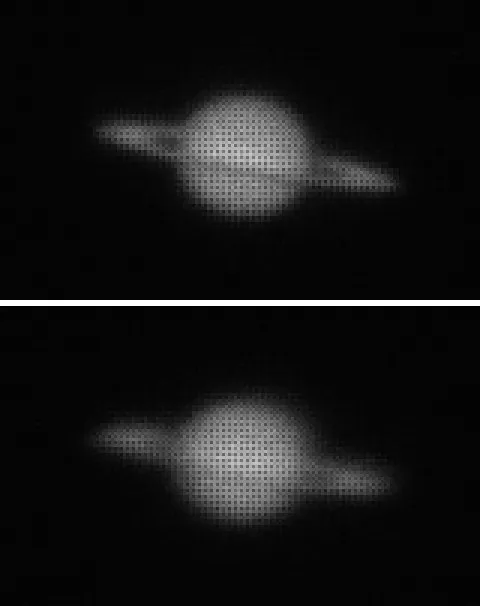
The wobble is the air: steady air holds a planet under 0.3. The sharpness changed completely from one half-second to the next, which focus cannot do. And the sharpest frame of a run, set beside a middling one, shows the ring gap where the other is smeared and doubled. But every frame was lower than on the good night, even the best, which looked like focus.
So I refocused at 21:45. Runs 11 to 14 came out the same as 7 to 10, to the decimal. It was the air. The tube may also still have been cooling for the first hour; I was imaging from 21:00 this time and from after 22:00 on the good night.
The processing, twice
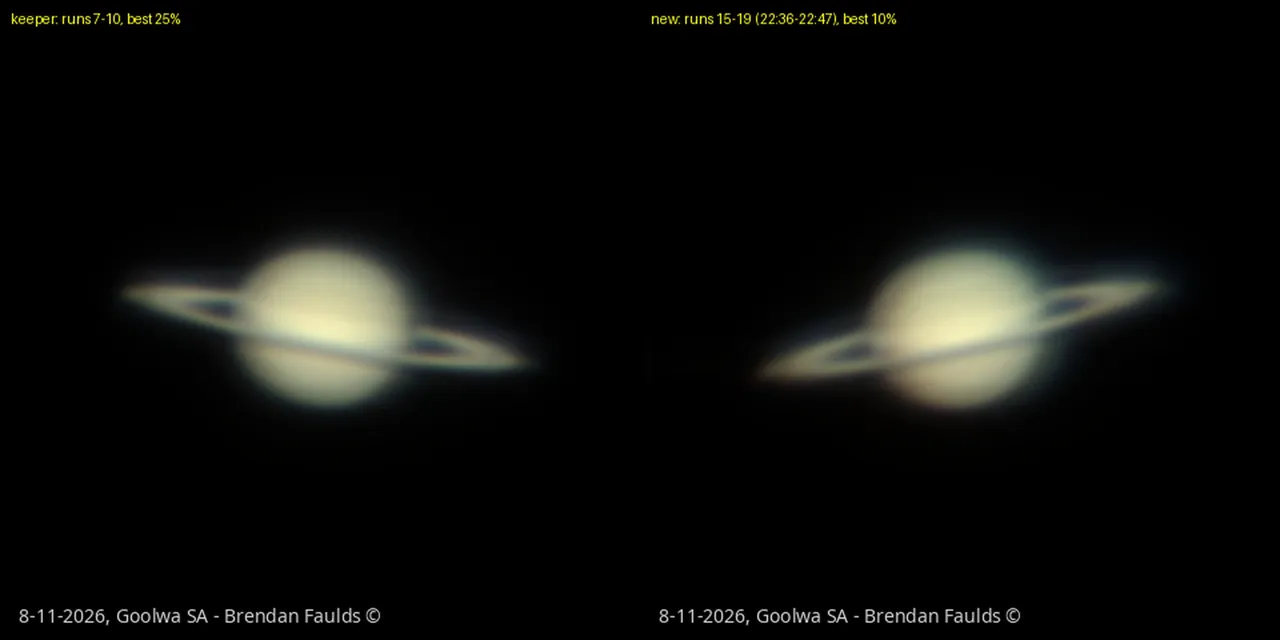
The planet stacker, sharpest quarter, then the finisher from the detail was in the recording. Keeper: runs 7 to 10, 4,472 frames over five minutes. I said it was too soft. Claude tried harder from the saved stacks: stronger deconvolution on runs 7 to 14 made the ring gap and the belt a little crisper; wavelet sharpening of the kind Registax does made it blurrier. Neither is a different picture.
Second try, 22:36. Saturn higher, six more runs, and this time the recordings kept so that only the sharpest tenth of frames could be stacked. 0.19 to 0.23. The same.
The rings turn. On an alt-az mount the picture rotates through the night, about 16 to 20 degrees an hour near the meridian at this height. Over a few minutes that smears the ring tips a little when runs are combined; the finisher lines runs up but does not turn them.
What the software got wrong
- Tracking died at the meridian, 22:30. At its highest Saturn's altitude barely changes, and the GTi cannot step slower than about 0.6 arcsec a second. The software only knew its own floor of 0.2, asked for 0.4, and the mount's arithmetic overflowed: tracking off on both axes. Fixed the same night: below the mount's slowest it now runs at that slowest rate, or stops the axis if that is closer.
- Calibrate cannot learn the ZWO on a planet. It needs detail across the picture.
- The finder crosshair was wrong for the Mak, by enough to hide a star. Reset.
- A goto with no alignment has no way to use a known home position. Worked around.
What I got wrong
- Clutches loose while asking the motors to move it.
- One alignment star again for the first half hour.
- Started at 21:00, before the tube had an hour outside.
Afterwards
All twenty recordings, 29 GB, deleted once the stacks and finals were on the Xeon and the Mac, checksummed. The second try's recordings were kept until I had seen it, then deleted too. Next time on a soft night the recordings stay until I have accepted the keeper.
Left for next time
- A steady night. Stars that barely twinkle. Nothing else will fix this.
- The tube outside an hour first.
- Two alignment stars from the start, far apart: Saturn and Fomalhaut, or Achernar.
- Derotate before combining runs that span more than a few minutes.